Saturday, November 08, 2008

An Assortment of Interesting Items

One of the more charming stories to hit the news this week was that the stick (That's not a fancy toy that happens to be named "The Stick". It is a stick--from a tree!) was inducted into the National Toy Hall of Fame this past Thursday. The cardboard box was inducted in 2005. These two items, along with others such as the bicycle and the baby doll, were chosen by the following criteria: "Each toy must not only be widely recognized and foster learning, creativity or discovery through play, but also endure in popularity over generations."

When I was growing up, we always lived out in the country rather than in town, so my brother and I had many opportunities to invent our own toys and games, as well as play with the store-bought variety. When I was ten, we moved to a new home and lo and behold! There in the creek bed was an old car body! It was filled with sand so we set to work digging out seats and had a grand time "driving" our car. Ah, the good ole days!

Do you enjoy classical music? Do you have a hard time finding radio stations that play such music? I have two such stations to recommend, both of which you can listen to online. Their websites also have links to the various programs they present so you can read background information or listen to a show you missed. The first station is KCSC/KBCW in Oklahoma. The second provides the overnight (11pm to 6am) content for the first--it is WCPE in North Carolina. For news, reviews, and other information about classical music, try Music & Vision or Andante. For the arts in general, try ArtsJournal.

Next Tuesday, 11 November, is Veterans Day. Read a brief history of the day here. May we always remember and honor our veterans.

Today's Geographical Location: The Isle of Man, located in the Irish Sea, chosen by me for no reason except that it looks interesting. See the website Isle of Man for all sorts of information about this island. This page has the general information that is the most interesting. Use the links on the left to learn about different aspects of the island. There is also a page at the CIA World Factbook. Background from the CIA's page:
Part of the Norwegian Kingdom of the Hebrides until the 13th century when it was ceded to Scotland, the isle came under the British crown in 1765. Current concerns include reviving the almost extinct Manx Gaelic language. Isle of Man is a British crown dependency but is not part of the UK. However, the UK Government remains constitutionally responsible for its defense and international representation.
I was surprised to learn that it is not part of the UK.

Labels: , , , ,

Saturday, June 23, 2007

Geography

If you are like me, you don't always have an accurate picture in your mind of where the places are that you read about in the news. It's easy enough to get a world map, a United States map, and an atlas or two (world or national), but it's also easy to find some geography sites on the internet. Three that I've found are:

About.com: Geography

Geography Network

Geography World

If you are in the market for a map or two, you could visit Maps which has all kinds of maps, atlases, globes, and travel guides. You can also find maps and such at local bookstores.

I find it helps me understand what is going on better if I can see a map and get an idea of the location. With the Middle East in the news so much, this is very useful to see how the countries are situated in relation to one another. Often, the geography sites such as the ones I listed above will give all kinds of information about a country--capitol, population, products, agriculture, etc. Needless to say, all this will help your kids with school as well as helping you know where things are happening.

Labels:

Monday, March 26, 2007

Easter Island in the South Pacific

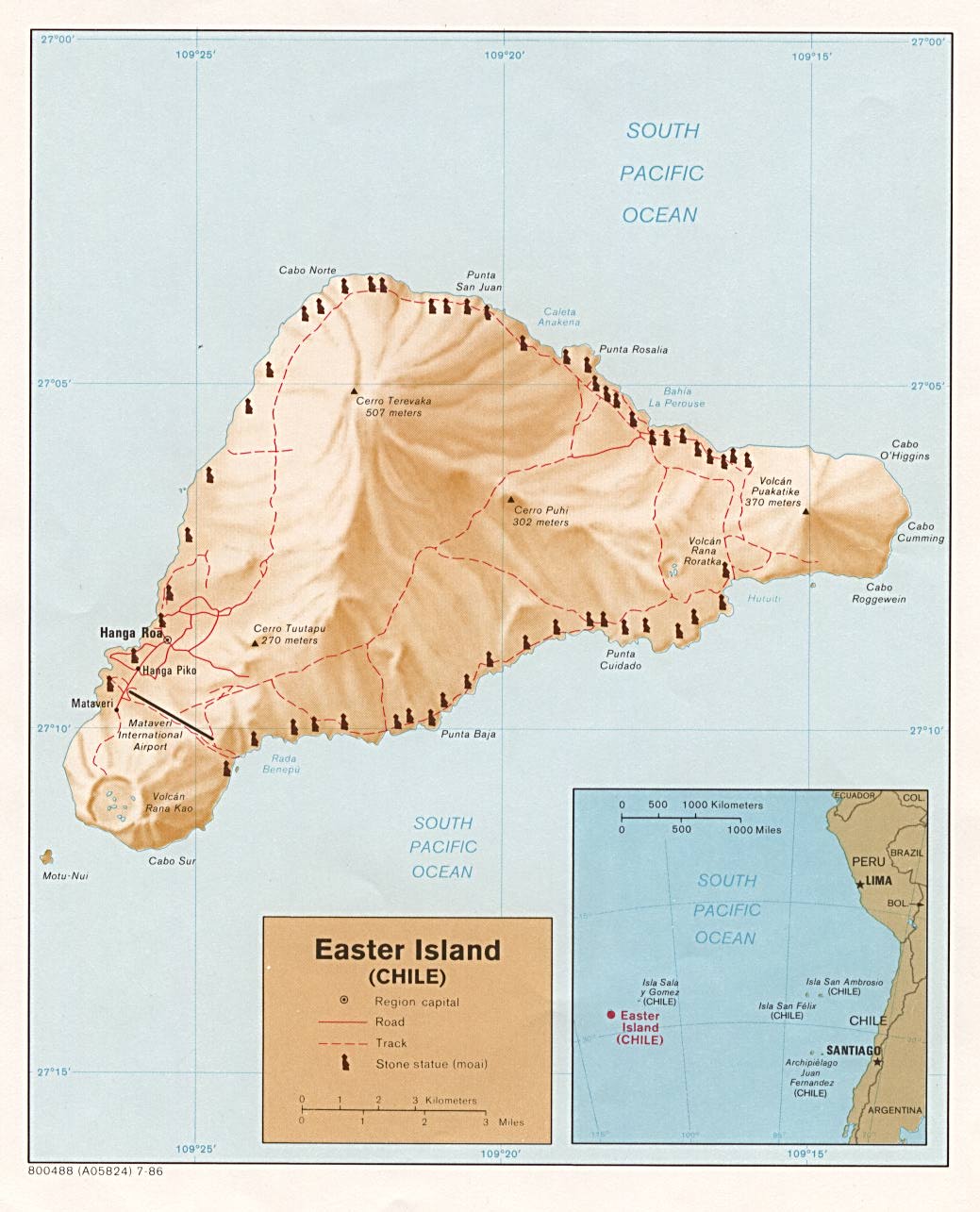
In a recent discussion with a friend about isolated islands, I was reminded of a documentary I saw several years ago about Easter Island. It focused on the giant statues and the history of the island, but also had a little about the current population. Looking on a map and seeing how far from anywhere Easter Island is, I had to wonder how anyone ever got there and, once they did, why they stayed. I don't have all the answers, but I have found some links to share with you about the island's history and current status. I have to say, though, that I would be afraid to live out in the middle of the ocean on a tiny piece of land. The ocean is so vast and deep and spawns tsunamis and typhoons. Still, Easter Island is interesting and, from what I've read and seen on the web, it has a certain charm.

I'm going to share four links with a variety of information and photos. You can, of course, do a search on Easter Island and get all sorts of material, from travel information to ecological information and everything in between. I had hoped to find more on the people who live there now and what they do, but had to settle for bits and pieces gleaned from articles about the history and the statues. If you know of a good link about modern day Easter Island, feel free to put the url in a comment.

The links:

Easter Island in Words and Pictures

Rapanui (Easter Island) by Dr. Grant McCall (book excerpt)

Easter Island History

Easter Island at Wikipedia (You know the drill--confirm wikipedia info with another source.) (Actually, that applies to anything!)

Also, there is a map of Easter Island here.

There are some minor discrepancies in details between the above sources, such as how far from other places Easter Island is, but you can get a nice overview of the island from these sources and the links they provide.

Easter Island is about 63 or 64 square miles in size and roughly triangular in shape. From the Easter Island History link above, we learn that:


Easter Island (or Rapa Nui) is one of the world’s great archaeological sites, and also one of the most remote. The nearest inhabited island is tiny Pitcairn, over 1,200 miles [1,931 kilometers] to the west. Rapa Nui is almost 2,500 miles [4,023 kilometers] from the coast of South America and, in the other direction, it is 2,000 miles [3,219 kilometers] to Tahiti. Its isolation is one of the key factors affecting the culture that evolved here.
Can you imagine living so far from other inhabited lands?!

The general story goes that the island got its name this way: "Easter Island's long isolation was ended on Easter Sunday in 1722 when a Dutch explorer, Jacob Roggeveen, found the island. He named it for the holy day." (Again, from the Easter Island History link above.)

The native name was Rapa Nui and that name is still used somewhat today. It is generally believed that Polynesian people settled on the island about 300-400 A.D., but some think the settlement was much later (800-1200 A.D). Some also believe there is South American influence, too, and not just Polynesian.

Wikipedia says, "Population at the 2002 census was 3,791 inhabitants, up from 1,936 inhabitants in 1982." There are people--a number of people--living there today. Tourism is a major income producer for the island, which has been annexed by Chile (and has a Spanish name of Isla de Pascua), although it has a local governor now. Dr. McCall's link above provides a factual summary of information about the island and, if you scroll down to the "History" section, you can read a detailed account of the island's dealings with Chile.

The Easter Island in Words and Pictures link will take you to a site with fantastic photos and a brief write-up of the basic information about the island.

I just think it is so fascinating that people found and settled such an isolated island. They settled in to stay and developed a civilization. They even had developed the only written language in Oceania (a name given the group of many islands in the Pacific), called rongorongo, which no one has been able to decipher. Thor Heyerdahl arrived in 1955 with the Norwegian Archaeological Expedition and they were the first to do excavations and attempt to come up with dates for the various findings.

This is just a brief summary of some of the information you can read about in the above links. The material is fairly short and the Easter Island in Words and Pictures page has a Resources page with a number of links.

Enjoy the geography lesson!

Labels: , ,